Every church has had the volume conversation. Someone says it's too loud, someone else says it has no energy, and the sound tech gets stuck in the middle. After a lot of years on stages and in sanctuaries, here's what I've seen: most volume complaints aren't really about the number on a meter. They're about harshness, mud and a mix that doesn't let people hear themselves sing.
The good news is that almost all of it can be fixed by the band and the booth working together.
Start with the stage, not the board
The sound tech can only turn things down in the room if the stage isn't already louder than the room needs. In a lot of small and mid-size churches, most of what the congregation hears in the first few rows comes straight off the stage: drums, guitar amps and floor wedges.
- Guitar amps. Turn them down and point them at the player, not the congregation. Tilt them back or put them on a stand so they aim at your ears instead of your knees. You'll hear yourself better at a lower level.
- Floor wedges. Every wedge is a speaker pointed at the congregation from the back. Fewer wedges, lower levels, and in-ear monitors where the budget allows.
- Drums. More on this below, because it's usually the biggest piece.
Drummers, this one's on us
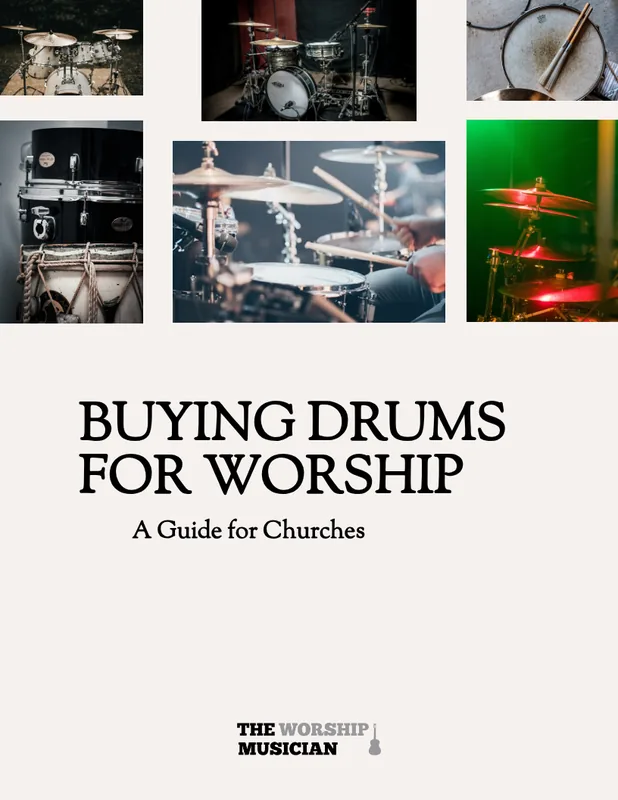
I say this as a drummer: an acoustic kit in a small room can be louder than the whole PA. That doesn't mean churches need electronic kits. It means drummers need dynamics.
- Play to the room, not to the kit. Big rooms and small rooms need different touch.
- Keep a pair of hot rods or brushes in your bag for quieter songs and smaller services.
- Tame the ring. Dampen the snare and toms a bit and use cymbals that aren't louder than the room needs.
- If the church uses a drum shield, it helps most when it's paired with a player who's already controlling their volume. It won't fix a heavy hand on its own.
Measure it instead of arguing about it
Get a decibel meter, or even a phone app, and walk the room during a service. Check a few seats: front, middle, back, sides. Use A-weighting and a slow response. Many churches with contemporary services land somewhere in the mid 80s to low 90s dBA for the loudest moments, but the right number is the one your leadership agrees on for your room and your people.
Once there's an agreed range, the conversation changes. It's no longer "it felt loud." It's "we were over our number in the second song, let's look at why."
Loud isn't the same as harsh
A mix can be at a reasonable level and still hurt. The usual suspects are a lot of energy in the upper midrange, cymbals that cut, and electric guitars stacked on top of the vocals. When people say "too loud" they're often reacting to that edge, not to the level. Taming the harsh frequencies and giving each instrument its own space in the mix usually does more than pulling the master fader down.
Let the congregation hear itself
This is the whole point. Congregational worship works when people can hear the people next to them singing. If the band buries the room, people stop singing and start watching. Keep the lead vocal clear and on top, keep the band supporting it, and leave room for the church.
Make it a team conversation
Volume problems usually get solved when the worship leader, the band and the sound team talk about them outside of Sunday morning. Agree on the goal, agree on the range, and give the sound tech permission to ask the stage to come down. Nobody should have to guess.
Getting the stage right is a big part of approaching your instrument like a pro. If that's where your team is, Approaching Your Instrument Professionally is a good short read, and drummers can dig deeper in Worship Drums: Prepare, Rehearse, Perform.